 You’ve spent time, energy and money developing and protecting your trademark…possibly even obtaining a federal trademark registration. Now what? Moving forward, you need to be careful to avoid several pitfalls that can result in the loss of your valuable trademark rights. Set forth below are several important considerations you should think about to avoid losing your rights as you continue to use your trademark and enforce your trademark rights against third parties:
1. Failure to use the trademark. Since trademark rights are based on use, a trademark owner must continue to use the trademark properly in order to avoid forfeiture of rights by abandonment. Non-use occurs when a trademark owner stops using the mark and does not intend to resume use. Further, intention not to resume use may be inferred from a trademark owner’s failure to use the mark for two consecutive years. Once a mark is deemed abandoned, all rights to it are lost.
2. Authorizing uncontrolled use of the trademark. Trademark rights can be lost if you license the trademark to others but don’t take adequate steps to monitor the style and quality of products or services associated with the trademark. After all, trademark law grants you exclusive use of the trademark in exchange for giving the consuming public a reliable indication of quality. If the level of quality falls below a certain level, you may be setting yourself up for cancellation of your trademark right.
3. Failure to enforce your rights against infringers. If you continually allow known infringers to violate your trademark rights, you effectively give up the right to challenge their use. While this might not result in cancellation of your registration, you are undermining your trademark by wilfully adopting a very narrow scope of protection.
4. Generic use. Generic use refers to the situation in which a trademark becomes so familiar that the distinction of the mark diminishes. We’re all familiar with the following trademarks which were allowed to become generic over time: aspirin, escalator, and linoleum. Rights to those trademarks were lost because appropriate steps were not taken to prevent the public from coming to regard the marks as generic products or services, rather than particular brand names.
If you have concerns about whether you are adequately protecting your trademarks, consider consulting a trademark professional who can help you implement procedures for maintaining and enforcing your rights.

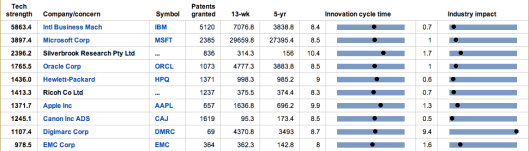 Click image for full WSJ Patent Board.
 Tomorrow, election workers are taking iPads to disabled voters who might otherwise have difficulties marking their ballots. These voters are able to pull up the ballot on the iPad and tap the screen to mark the candidate of their choice before printing out their completed ballot and send it in by mail.
 Michael Jackson was more than a great singer and dancer. He was also an inventor and U.S. Patent owner. Granted in 1993 to Jackson and two partners, U.S. Patent No. 5,255,452, “Method and Means for Creating Anti-Gravity Illusion” covers a “system for allowing a shoe wearer to lean forwardly beyond his center of gravity by virtue of wearing a specially designed pair of shoes.” The shoes help create the anti-gravity illusion by hitching a heel slot in the shoes to a peg in the stage floor. The patent ended early, on Oct. 26, 2005, after failure to pay a final maintenance fee. Michael’s other legal fees may have taken precedence, or perhaps he felt there was no longer any competitive advantage to doing a “Smooth” lean. The full patent is available through the


 Nonprofits, if you have an affinity credit card program, have you checked that it meets all requirements to fall within the royalties exclusion from unrelated business income? Failure to comply can have significant tax ramifications.



 Oregon Intellectual Property Blog