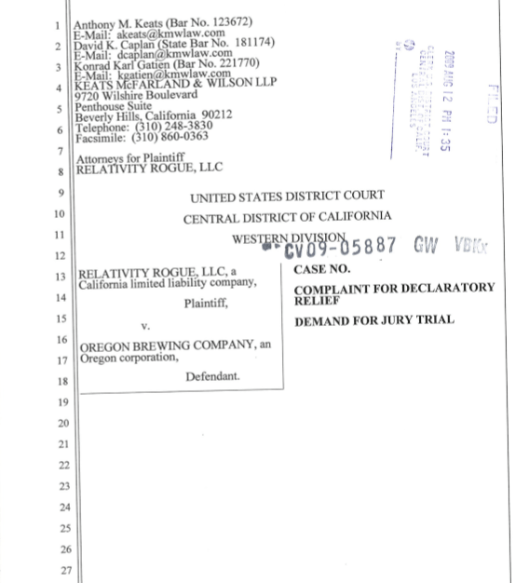
Oregon Trademark Litigation Update – Relativity Rogue, LLC v. Oregon Brewing Company

Case Number: 2:09-cv-05887-GW-VBK
File Date: Wednesday, August 12, 2009
Plaintiff: Relativity Rogue, LLC
Plaintiff Counsel: Anthony M. Keats, David K. Caplan, Konrad K. Gatien of Keats McFarland & Wilson LLP
Defendant: Oregon Brewing Company
Cause: 15:1051 Trademark Infringement
Court: California Central District Court
Judge: Judge George H. Wu
Referred To: Magistrate Judge Victor B. Kenton

roguestout

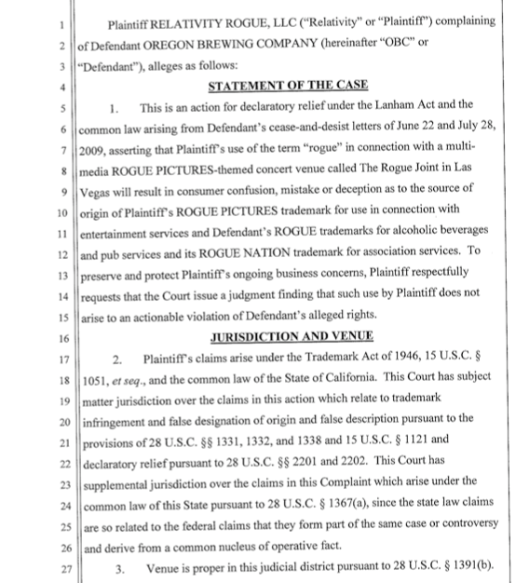
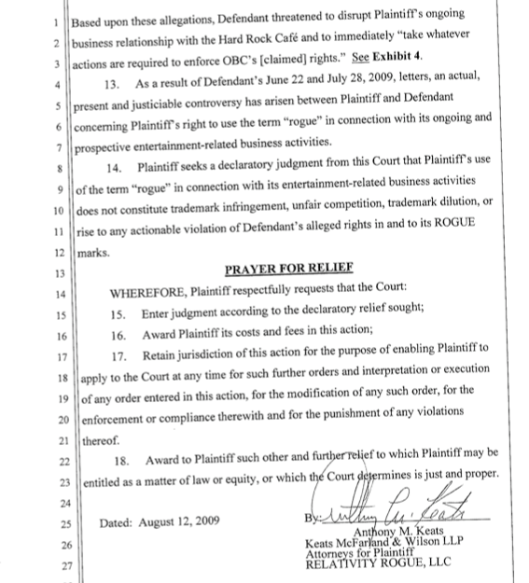
A California-based film production company named Relativity Rogue (“Relativity”) has filed an action for declaratory relief against Oregon Brewing Company (“OBC,” a.k.a. the makers of fine Rogue ales).  OBC sent cease & desist letters in June and July, 2009, asserting that Relativity’s use of the term “rogue” in connection with a multi-media ROGUE PICTURES-themed  concert venue called The Rogue Joint in Las Vegas will result in consumer confusion with OBC’s ROGUE trademarks for alcoholic beverages.  Rather than quibble about it, Relativity decided it would just go ahead and have the issue decided by the California Central District Court, filing this Complaint for Declaratory Relief.  Relativity seeks a judgment that it’s use of the term “rogue” in connection with its entertainment-related business activities does not constitute trademark infringement, unfair competition, trademark dilution, or rise to any actionable violation of OBC’s rights in the ROGUE marks.  Way to take the initiative, Relativity!

This quick trigger by Relativity makes me think this is either a part of their settlement strategy or the parties just came to an impasse in negotiations.  Either way, the court will now attempt to settle their rights in the public eye, for better or worse.  I’ll update you as this matter proceeds.

Picture 1

Picture 2

Picture 3

For a copy of the full complaint, please leave a comment with your email.

Green Startup Sues Printing Giant in Oregon District Court

greenprojectlogoA local green startup firm has counter-sued a printing giant, claiming that it illegally cracked down on the right to resell its used product.

Hacienda Heights-based Green Project Inc. alleges in a lawsuit filed July 27 in U.S. District Court in Oregon that Epson America Inc. and its parent, Japan-based Seiko Epson Corp., sent a company spy into the Green Project facility to gain access to trade secrets.

The company also claims that Epson punished it and firms like it for reselling recycled Epson cartridges.

Epson, which first filed a lawsuit against Green Project and several other firms in April over alleged patent infringement, denies all charges.

“My reaction (to the allegations) is they are B.S. and designed to create a posture for Green Project … and that there’s no substance to them,” said David W. Axelrod, a lead attorney for Epson. But in its countersuit, Green Project says Epson’s infringement claims don’t stand up against the “first sale doctrine,” a legal approach that says a patent owner’s rights to intellectual property end once a particular product has been sold to the public. Green Project, a company of 13 employees, does business by “re-manufacturing” ink and toner cartridges for use on major manufacturers’ printers, including Epson’s.

The year-old company touts the service as good for the environment, since it takes discarded cartridges and puts them to new use.

“It’s not that we are looking for p.r.,” said Green Project President Joseph Wu. “Our goal is to recycle Epson’s cartridges. If we don’t, they go to landfills. We are recycling and looking to reduce e-waste, but also to make a business.”

EpsonLogoThe company thought it was doing business when Herbert W. Seitz allegedly called – using another name – looking to buy cartridges from Green Project and ultimately sell them at his Huntington Beach firm, Wu said. As part of that business, Green Project sent price lists and other secret information to Seitz, who turned out to be an Epson employee, Wu alleged, adding that within a couple of days, Seitz showed up in the company warehouse without permission.

“The issue is that when Epson did come to us, they came under false pretenses,” Wu said.

Green Project accuses Epson – one of the largest manufacturers of printers – of trade secret misappropriation and trespassing, and denies Epson’s claims of patent infringement.

But Epson’s lawyers maintain they have a case against Green Project.

Axelrod pointed to the “first sale” doctrine, adding that the doctrine of first sale does not apply in this case, because there is evidence the used cartridges were collected out of the U.S. Wu said his firm works with brokers who document that cartridges were collected in the U.S.

Wu’s company is seeking to be dropped from Epson’s original suit, and for Epson to pay damages and legal fees. It’s also looking to stop Epson from using any secrets that Seitz allegedly obtained.

Epson wants the firms named in the lawsuit to pay damages and for its patents to be enforced.

Source: SGVTribune.com

Oregon Man Sentenced for First-Degree Trademark Counterfeiting

OREGON CITY — A Happy Valley man will serve 40 days in jail for selling counterfeit Rolex watches, iPods and designer apparel on the Internet.  Gordon Kean Dye, 52, also will pay a $500 fine, pay for his extradition from Texas and remain on probation for two years after he completes his jail term.

Dye was arrested by FBI agents in September 2008, during a crackdown on intellectual property rights violations. After agents obtained a search warrant, they found Dye with several bogus items he bought in Mexico, including 20 bogus Rolex watches, Coach handbags, Nike apparel and items bearing the prestigious Prada label. The counterfeit goods were manufactured in China.

rolex

Dye faced charges in both Washington and Clackamas counties. Prosecutors in both counties worked together and negotiated coordinated pleas.

On Friday, Dye pleaded guilty in Washington County Circuit Court to second-degree trademark counterfeiting.

Today, he pleaded guilty in Clackamas County Circuit Court to first-degree trademark counterfeiting, second-degree trademark counterfeiting and third-degree trademark counterfeiting.

Dye offered a simple apology to Judge Steven L. Maurer.

“I’m sorry for being here, your honor, in this courtroom,” he said.

Source: The Oregonian

coach-patch-tote

The Trademark Counterfeiting statute appears below.  Click the links above to see the penalty for each degree of counterfeiting.

CHAPTER 647—Trademarks and Service Marks; Oregon Revised Statutes 647.135
(1) A person commits trademark counterfeiting if the person knowingly and with the intent to sell or distribute and without the consent of the registrant uses, displays, advertises, distributes, offers for sale, sells or possesses any item that bears a counterfeit of a mark or any service that is identified by a counterfeit of a mark registered under this chapter or registered under this chapter or registered under 15 U.S.C. 1052 with knowledge that the mark is counterfeit.

(2) For purposes of this section, a mark is counterfeit if:

(a) It is a mark that is identical to or substantially indistinguishable from a registered mark; and

(b) It is used on or in connection with the same type of goods or services for which the genuine mark is registered.

(3) A person does not commit trademark counterfeiting if the person has adopted and lawfully used the same or a confusingly similar mark in the rendition of like services or the manufacture of like goods in this state from a date before the effective date of registration of the service mark or trademark and continues to use the mark after the effective date of registration.

Stay out of trouble, kids!

Oregon Harmonizes State Trademark Law with Federal Law

NEW YORK, NY – The International Trademark Association (INTA) announced its support to the state of Oregon as they recently signed into law legislation that harmonizes Oregon trademark law with federal trademark law and reflects principles contained in the Model State Trademark Bill (MSTB) developed by INTA, according to the Association.

“By enacting this legislation, Oregon once again shows its dedication to protecting businesses and consumers by providing assistance and support for growth in this ailing economy. We commend Oregon for taking action and for its leadership to other states as they consider similar laws,” INTA Executive Director Alan Drewsen said.

This legislation will help to stimulate growth of the Oregon economy by ensuring full state trademark protection for businesses.  The new Act prohibits trademark infringement and provides that damages awarded may be three times the injury in a case of bad faith or knowing infringement.

“This new law is the result of businesses and government working together to achieve a long-needed update to Oregon’s trademark statute, and it will benefit both the state’s economy and consumers,” Anne Glazer, a partner in the law firm of Stoel Rives LLP stated.

“Oregonians and others who rely on the state law will now see the advantages of greater harmonization among state and federal trademark laws,” he added.

Forty-six states have adopted some form of the model state trademark law, but Oregon becomes the third state, along with California and Mississippi, to adopt the newest version of the model bill which provides a cause of action for trademark dilution for marks that are famous within the state, and sets forth definitions and standards consistent with the federal Trademark Dilution Revision Act of 2006.

Source: ag-IP-news

oregon

Copyright Protection of Lecture Notes

‘My economics teacher is forcing us to give up all of our work for the semester. Every page of notes and paper must be turned over to her to be destroyed to prevent future students from copying it. My binder was in my backpack, and she went into my backpack to take it. Is that legal?’ Besides the issue with private property invasion, which was the trigger of that post, there is much more important question: Can a teacher ask a student not to retain knowledge? How does IP law relate to teaching and sharing knowledge? Whose property are those notes?”from Slashdot

lecturerI came across this question and wanted to comment.  I won’t turn this into a full-blown legal analysis of copyright protection of class lecture notes, but there are some ideas I felt were important enough to mention.  Leaving aside the issue of the teacher going into the backpack, I’ll focus on the IP question because it just seems to keep popping up.  It’s a thorny issue that really shouldn’t be all that thorny.

First, keep in mind that facts and ideas are not protected by copyright.  Only the “expression” of facts or ideas can be protected.  When a student writes down notes from a lecture, he is primarily concerned with documenting the important facts and ideas of the lesson.  Any elements of the teacher’s expression that are copied into the notes are typically ancillary and of little real value to the student. Going further, it should be recognized that the facts and ideas that a teacher lectures on are primarily repackaged information that the teacher has derived from other sources.  A teacher seeking to enforce copyright ownership of this information is farcical at best.

I understand that classroom dynamics have been changing rapidly over the last few decades, with the introduction of photocopies, digital recorders, email, etc.  The “expression” of ideas, as opposed to the ideas themselves, can increasingly be captured verbatim.  Hence the growing and potentially misguided belief that copyright law needs to step in to protect a teacher’s expression of the facts. To the contrary, teachers need to get innovative and figure out how to embrace these technologies to further their one real goal…educating students.

Last year, a University of Florida professor brought a suit filled with interesting copyright claims against a commercial note-taking service.  To summarize, this service was paying students to take class notes and then sellingthose notes online as study aids.  I haven’t been able to locate an update to see how that case was resolved…it may have settled.  If someone has more information on the outcome, please leave a comment.  Regardless, the situation described in the question above does not involve a commercial note-taking service, just a tuition-paying, education-seeking economics student.  Therefore, many of the commercial elements that made the Florida professor’s copyright claims somewhat palatable do not exist here.

I find it remarkable that any teacher would ask a student to hand in all of their class resources at the end of a semester.  After all, there are actually students who go to university to gain knowledge they can use for the rest of their life…not just for the length of one semester and to be forgotten upon handing in the final exam.  Class materials, including quizzes, tests and lecture notes, are often important resources later in a student’s professional life.  Is the threat of future students copying the notes really so severe that it outweighs the potential value to the note-taking student?

President Obama Addresses Innovation, Tech Issues in Cairo

Earlier today, President Obama spoke on American and Muslim relations.  At Egypt’s Cairo University, Obama discussed Islam’s glories and rights, the legitimate rights of Israel and the Palestinians, Iranian nuclear aspirations, the wars in Iraq and Afghanistan, women’s rights, religious rights and democracy in the Muslim world.

The U.S. President’s speech also discussed economic development and tech innovations, the full text of which appears below (video starts at 45:43):

“Finally, I want to discuss economic development and opportunity.

I know that for many, the face of globalization is contradictory.  The Internet and television can bring knowledge and information, but also offensive sexuality and mindless violence into the home.  Trade can bring new wealth and opportunities, but also huge disruptions and change in communities.  In all nations — including America — this change can bring fear.  Fear that because of modernity we lose control over our economic choices, our politics, and most importantly our identities — those things we most cherish about our communities, our families, our traditions, and our faith.

But I also know that human progress cannot be denied.  There need not be contradictions between development and tradition. Countries like Japan and South Korea grew their economies enormously while maintaining distinct cultures.  The same is true for the astonishing progress within Muslim-majority countries from Kuala Lumpur to Dubai.  In ancient times and in our times, Muslim communities have been at the forefront of innovation and education.

And this is important because no development strategy can be based only upon what comes out of the ground, nor can it be sustained while young people are out of work.  Many Gulf states have enjoyed great wealth as a consequence of oil, and some are beginning to focus it on broader development.  But all of us must recognize that education and innovation will be the currency of the 21st century — (applause) — and in too many Muslim communities, there remains underinvestment in these areas.  I’m  emphasizing such investment within my own country.  And while America in the past has focused on oil and gas when it comes to this part of the world, we now seek a broader engagement.

On education, we will expand exchange programs, and increase scholarships, like the one that brought my father to America.  (Applause.)  At the same time, we will encourage more Americans to study in Muslim communities.  And we will match promising Muslim students with internships in America; invest in online learning for teachers and children around the world; and create a new online network, so a young person in Kansas can communicate instantly with a young person in Cairo.

On economic development, we will create a new corps of business volunteers to partner with counterparts in Muslim-majority countries.  And I will host a Summit on Entrepreneurship this year to identify how we can deepen ties between business leaders,
foundations and social entrepreneurs in the United States and Muslim communities around the world.

On science and technology, we will launch a new fund to support technological development in Muslim-majority countries, and to help transfer ideas to the marketplace so they can create more jobs.  We’ll open centers of scientific excellence in Africa, the Middle East and Southeast Asia, and appoint new science envoys to collaborate on programs that develop new sources of energy, create green jobs, digitize records, clean water, grow new crops.  Today I’m announcing a new global effort with the Organization of the Islamic Conference to eradicate polio.  And we will also expand partnerships with Muslim communities to promote child and maternal health.

All these things must be done in partnership.  Americans are ready to join with citizens and governments; community organizations, religious leaders, and businesses in Muslim communities around the world to help our people pursue a better life.”

Click here for the full transcript.

Sotomayor’s Supreme Court Case History – Intellectual Property

During Supreme Court nominee Sonia Sotomayor’s 17 years as a federal judge, the U.S. Supreme Court has reviewed her decisions on at least eight occasions, including the following copyright case:

Tasini vs. New York Times, et al (1997), 972 F. Supp. 804: As a district court judge in 1997, Sotomayor heard a case brought by a group of freelance journalists who asserted that various news organizations, including the New York Times, violated copyright laws by reproducing the freelancers’ work on electronic databases and archives such as “Lexis/Nexis” without first obtaining their permission. Sotomayor ruled against the freelancers and said that publishers were within their rights as outlined by the 1976 Copyright Act. The appellate court reversed Sotomayor’s decision, siding with the freelancers, and the Supreme Court upheld the appellate decision (therefore rejecting Sotomayor’s original ruling). Justices Stevens and Breyer dissented, taking Sotomayor’s position.

Source: CNN

Sonia Sotomayor, Obama’s Pick for Supreme Court, has IP Background

sotomayorPresident Obama has selected Sonia Sotomayor to fill the Supreme Court seat left vacant by retiring Justice Souter. Prior to being selected to the federal bench in 1991 by George Bush, Sotomayor was in private practice in New York…and her specialty was intellectual property law. She represented clients like Ferrari and Fendi in intellectual property, commodities trading and business cases.

The president had said publicly that he wanted a justice who combined intellect and empathy — someone who could understand the troubles of everyday Americans.

From an IP viewpoint, let’s hope her background can help the Supreme Court make some sense out of upcoming copyright and patent litigation.

Here is a brief biography of federal Judge Sonia Sotomayor:

Age 54 (Born June 25, 1954)

Judicial Career
– U.S. Appeals Court judge, 2nd Circuit, 1998-present
– U.S. District Court judge, 1992-1998
– Nominated to federal bench by Bush in 1991, Clinton in 1997

Government/Legal Career
– Former N.Y. County Assistant District Attorney, 1979-1984
– Former private practice attorney, Pavia & Harcourt, New York, 1984-1992

Politics
– Confirmed by Senate 67-29 in 1998
– Confirmation to current seat took over 1 year
– Was opposed by majority of Republican senators
– Was unopposed in 1991 confirmation process

Education
– J.D., Yale Law School, 1979
– B.A., Princeton, 1976 (summa cum laude)

Academic Positions
– Adjunct Professor, New York University School of Law since 1998
– Lecturer-in-law, Columbia Law School since 1999

Professional Associations
– American Bar Association
– Puerto Rican Bar Association
– Hispanic National Bar Association
– Association of Judges of Hispanic Heritage
– New York Women’s Bar Association

Judicial Committees & Activities
Former Member, Second Circuit Task Force on Gender, Racial and Ethnic Fairness
in the Courts

Other Activities
– Former Member, Board of Directors, New York City Campaign Finance Board
– Former Member, Board of Directors, State of New York Mortgage Agency
– Former Member, Board of Directors, Puerto Rican Legal Defense & Education
Fund
– Former Member, Board of Directors, Maternity Center Association
– Former Member, New York City Campaign Public Finance Board (Mayor’s
Appointee)
– Former Member, Board of Directors, State of New York Mortgage Agency
(Governor’s Appointee)

Honors & Awards
– Herbert L. Lehman College, Degree of Law Honoris Causa, 1999
– Brooklyn Law School Degree of Juris Doctor Honoris Causa, 2001
– Princeton Univ., Degree of Juris Doctor Honoris Causa, 2001

Publications
– Statehood and the Equal Footing Doctrine: The Case for Puerto Rican Seabed
Rights, 88 Yale Law Journal 825 (1979)
– Sonia Sotomayor & Nicole A. Gordon, Returning Majesty to the Law and
Politics: A Modern Approach, 30 Suffolk U.L. Rev. 35 (1996)

iTunes DRM pits Apple against EFF, Beaverton-based OdioWorks

The Electronic Frontier Foundation filed a lawsuit against Apple on Monday.

Here’s the story so far: Late last year, an anonymous contributor to the BluWiki wiki site began a discussion about a project called Ipodhash, whose goal was to reverse-engineer the digital rights management system in the latest version of Apple’s iTunes.  The ultimate purpose of Ipodhash was to let iPhone and iPod users run alternatives to iTunes, such as Banshee and Songbird. Hackers have been successful at cracking Apple’s system in the past.  In November ’08, Apple lawyers sent a cease and desist letter to the host of the BlueWiki site, Beaverton, Oregon based OdioWorks.  Apple’s claim was that Ipodhash violated the Digital Millennium Copyright Act.

For the full story and analysis, see The Industry Standard.

President Obama Announces Members of Science and Technology Advisory Council

Under my administration, the days of science taking a back seat to ideology are over. Our progress as a nation – and our values as a nation – are rooted in free and open inquiry. To undermine scientific integrity is to undermine our democracy. It is contrary to our way of life.” – President Barack Obama, 4/27/09

pcastPresident Barack Obama has announced the President’s Council of Advisors on Science and Technology (PCAST). PCAST will advise President Obama about national strategies to nurture and sustain a culture of scientific innovation. The list of advisors includes a number of academics, as well as Google CEO Eric Schmidt and Microsoft’s chief research and strategy officer, Craig Mundie.  Also included is OHSU’s VP of Medical Affairs, Christine Cassel.  Let’s hope they give the President some great advice!

Below is the full PCAST roster, with links to full bios:

Rosina Bierbaum, a widely-recognized expert in climate-change science and ecology, is Dean of the School of Natural Resources and Environment at the University of Michigan. Her PhD is in evolutionary biology and ecology. She served as Associate Director for Environment in OSTP in the Clinton Administration, as well as Acting Director of OSTP in 2000-2001. She is a member of the American Academy of Arts and Sciences.

Christine Cassel is President and CEO of the American Board of Internal Medicine and previously served as Dean of the School of Medicine and Vice President for Medical Affairs at Oregon Health & Science University. A member of the US Institute of Medicine, she is a leading expert in geriatric medicine and quality of care.

Christopher Chyba is Professor of Astrophysical Sciences and International Affairs at Princeton University and a member of the Committee on International Security and Arms Control of the National Academy of Sciences. His scientific work focuses on solar system exploration and his security-related research emphasizes nuclear and biological weapons policy, proliferation, and terrorism. He served on the White House staff from 1993 to 1995 at the National Security Council and the Office of Science and Technology Policy and was awarded a MacArthur Prize Fellowship (2001) for his work in both planetary science and international security.

S. James Gates Jr. is the John S. Toll Professor of Physics and Director of the Center for String and Particle Theory at the University of Maryland, College Park. He is the first African American to hold an endowed chair in physics at a major research university. He has served as a consultant to the National Science Foundation, the U.S. Departments of Energy and Defense, and the Educational Testing Service and held appointments at MIT, Harvard, California Institute of Technology and Howard University.

John Holdren is serving as co-chair of PCAST in addition to his duties as Director of the Office of Science and Technology Policy in the Executive Office of the President and Assistant to the President for Science and Technology. Prior to this appointment Dr. Holdren was a Professor of Environmental Policy and Director of the Program on Science, Technology, and Public Policy at Harvard University’s Kennedy School of Government. He also served concurrently as Professor of Environmental Science and Policy in Harvard’s Department of Earth and Planetary Sciences and as Director of the independent, nonprofit Woods Hole Research Center. He is a member of the National Academy of Sciences, the National Academy of Engineering, and the American Academy of Arts and Sciences, as well as a former President of the American Association for the Advancement of Science and recipient of the MacArthur Foundation Prize Fellowship.

Shirley Ann Jackson is the President of Rensselaer Polytechnic Institute and former Chair of the US Nuclear Regulatory Commission (1995-1999). She is the University Vice Chairman of the U.S. Council on Competitiveness, a member of the National Academy of Engineering, fellow of the Academy of Arts and Sciences, and past President of the American Association for the Advancement of Science. Dr. Jackson was the first African American woman to earn a doctorate from MIT and chairs the New York Stock Exchange Regulation Board.

Eric Lander is serving as a co-chair of PCAST. He is the Director of the Broad Institute of MIT and Harvard and Professor of Biology at MIT, Professor of Systems Biology at Harvard Medical School and member of the Whitehead Institute for Biomedical Research. He was one of the principal leaders of the Human Genome Project, recipient of the MacArthur Foundation Prize Fellowship and is a member of both the National Academy of Sciences and Institute of Medicine.

Richard Levin has served as President of Yale University since 1993 and is a distinguished economist with interests in industrial organization, the patent system, and the competitiveness of American manufacturing industries, including industrial research and development, intellectual property, and productivity. He is a leader in US-China cooperation, in research and education, and is a member of the American Academy of Arts and Sciences.

Chad Mirkin is Professor of Materials Science and Engineering, Chemistry, and Medicine at Northwestern University, as well as Director of Northwestern’s International Institute of Nanotechnology. He is a leading expert on nanotechnology, including nano-scale manufacturing and applications to medicine. Awarded the Feynman Prize in Nanotechnology in 2002, he is one of the top-cited researchers in nano-medicine, as well as one of the most widely cited chemists.

Mario Molina is a Professor of Chemistry and Biochemistry at the University of California, San Diego and the Center for Atmospheric Sciences at the Scripps Institution of Oceanography, as well as Director of the Mario Molina Center for Energy and Environment in Mexico City. He received the Nobel Prize in Chemistry in 1995 for his role in elucidating the threat to the Earth’s ozone layer of chlorofluorocarbon gases. The only Mexican-born Nobel laureate in science, he served on PCAST for both Clinton terms. He is a member of both the National Academy of Sciences and the Institute of Medicine.

Ernest J. Moniz is a Professor of Physics and Engineering Systems, Director of the Energy Initiative, and Director of the Laboratory for Energy and the Environment at MIT. His research centers on energy technology and policy, including the future of nuclear power, coal, natural gas, and solar energy in a low-carbon world. He served as Under Secretary of the Department of Energy (1997-2001) and Associate Director for Science in the White House Office of Science and Technology Policy (1995-1997).

Craig Mundie is Chief Research and Strategy Officer at Microsoft Corporation. He has 39 years of experience in the computer industry, beginning as a developer of operating systems. Dr. Mundie co-founded and served as CEO of Alliant Computer Systems.

William Press is Professor of Computer Sciences at the University of Texas at Austin, has wide-ranging expertise in computer science, astrophysics, and international security. A member of the US National Academy of Sciences, he previously served as Deputy Laboratory Director for Science and Technology at the Los Alamos National Laboratory from 1998 to 2004. He is a Professor of Astronomy and Physics at Harvard University and a former member of the Harvard-Smithsonian Center for Astrophysics (1982-1998).

Maxine Savitz is retired general manager of Technology Partnerships at Honeywell, Inc and has more than 30 years of experience managing research, development and implementation programs for the public and private sectors, including in the aerospace, transportation, and industrial sectors. From 1979 to 1983 she served as Deputy Assistant Secretary for Conservation in the US Department of Energy. She currently serves as vice-president of the National Academy of Engineering.

Barbara Schaal is Professor of Biology at Washington University in St Louis. She is a renowned plant geneticist who has used molecular genetics to understand the evolution and ecology of plants, ranging from the US Midwest to the tropics. Dr Schaal serves as Vice President of the National Academy of Sciences, the first woman ever elected to that role.

Eric Schmidt is Chairman and CEO of Google Inc. and a member of the Board of Directors of Apple Inc. Before joining Google, Dr. Schmidt served as Chief Technology Officer for Sun Microsystems and later as CEO of Novell Inc.

Daniel Schrag is the Sturgis Hooper Professor of Geology in the Department of Earth and Planetary Sciences at Harvard University and Professor of Environmental Science and Engineering in the School of Engineering and Applied Sciences. He is also Director of the Harvard University-wide Center for Environment. He was trained as a marine geochemist and has employed a variety of methods to study the carbon cycle and climate over a wide range of Earth’s history. Awarded a MacArthur Prize Fellowship in 2000, he has recently been working on technological approaches to mitigating future climate change.

David E. Shaw is the chief scientist of D. E. Shaw Research, LLC, where he leads an interdisciplinary research group in the field of computational biochemistry. He is the founder of D. E. Shaw & Co., a hedge fund company. Dr. Shaw is a former member of PCAST under President Clinton and a member of the executive committee of the Council on Competitiveness, where he co-chairs the steering committee for the Council’s federally funded High-Performance Computing Initiative. He is a fellow of the American Academy of Arts and Sciences and serves on the Computer Science and Telecommunications Board of the National Academies.

Harold Varmus is the President and CEO of Memorial Sloan-Kettering Cancer Center and co-chair of PCAST. Dr. Varmus served as the Director of the National Institutes of Health from 1993 to 1999 and in 1989 was the co-recipient of the Nobel Prize for Physiology or Medicine for his pioneering studies of the genetic basis of cancer. He is a member of the National Academy of Sciences and Institute of Medicine and recipient of the National Medal of Science.

Ahmed Zewail is Professor of Chemistry and Physics at Caltech and Director of the Physical Biology Center. Dr. Zewail was awarded the Nobel Prize in Chemistry in 1999 for his pioneering work that allowed observation of exceedingly rapid molecular transformations. He is an Egyptian-American, widely respected not only for his science but also for his efforts in the Middle East as a voice of reason. Dr. Zewail is a member of the National Academy of Sciences, and postage stamps have been issued to honor his contributions to science and humanity.