• About
  • Contact
  • Disclaimer
  • Oregon IP Resources

Oregon Intellectual Property Blog

Oregon Intellectual Property Blog

Category Archives: Trademark

Oregon Trail Owners Sue Zynga, Maker of Frontierville

20 Friday May 2011

Posted by Kenan Farrell in Copyright, Intellectual Property, Litigation, Oregon, Trademark

≈ Leave a comment

Interesting IP litigation story from Kotaku:

The May 30 launch of an “Oregon Trail” expansion pack in the popular Facebook game Frontierville has caught notice of the company holding the copyright to the edutainment classic, and it has sued to put a stop to the plans of Frontierville maker Zynga.

The lawsuit, filed by The Learning Company in federal court in Massachusetts, alleges that Zynga cut a trailer for its “Oregon Trail” missions (above) that highlights similarities between them and the The Oregon Trail notably “setting up a wagon, provisioning, hunting, fording rivers, and helping others.” For the record, the trailer refers not to dysentery but “the Rocky Mountain Scoots.”

[Yes, the lawsuit is going on in Massachusetts but I couldn’t avoid mentioning it here.]

Full Complaint:

View this document on Scribd

Check out Gamasutra for more details.

Oregon’s Kettle Foods, Nike Jordan are ‘Hottest Brands’

05 Wednesday Jan 2011

Posted by Kenan Farrell in Oregon, Trademark

≈ Leave a comment

Tags

Jet Blue, Kettle Foods, Pepto Bismol, Trademark

Two of Advertising Age’s “Hottest Brands of the Year” are linked to Oregon companies, the industry publication announced recently.

Salem-based Kettle Foods and Nike’s Jordan brand were singled out for the annual acknowledgement, which singled out 40 brands for success in 2009 — everything from Pepto Bismol to airline Jet Blue.

Kettle earned its nod for record growth and marketing innovation, for which the company credited its long-standing public relations firm, Maxwell PR.

“As our primary marketing engine public relations has done the heavy lifting for Kettle Brand,” Michelle Hunt, vice president of marketing for Kettle Foods, said in a statement. “With a limited budget and the bar set high, Maxwell has continued to keep the brand fresh and our fans engaged – and it’s paid off with significant and sustained growth.”

Keith Houlemard, president of Beaverton-based Nike’s Jordan brand, was singled out for his leadership of the business unit.

Since deciding to drop Nike’s trademark Swoosh from its sneakers more than a decade ago, the brand has grown to dominate the high-end basketball market, Ad Age reported.

Source: Portland Business Journal

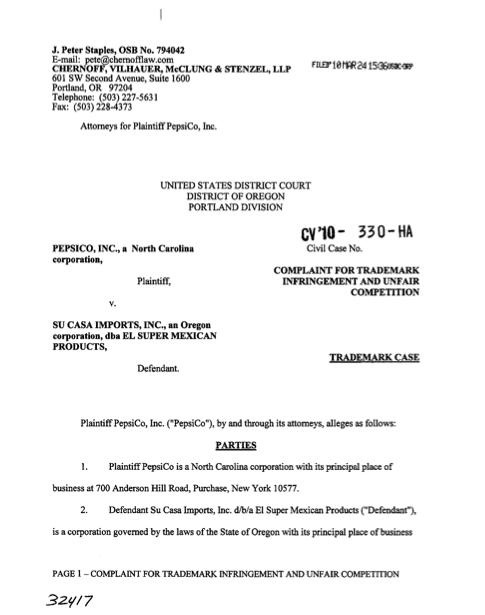
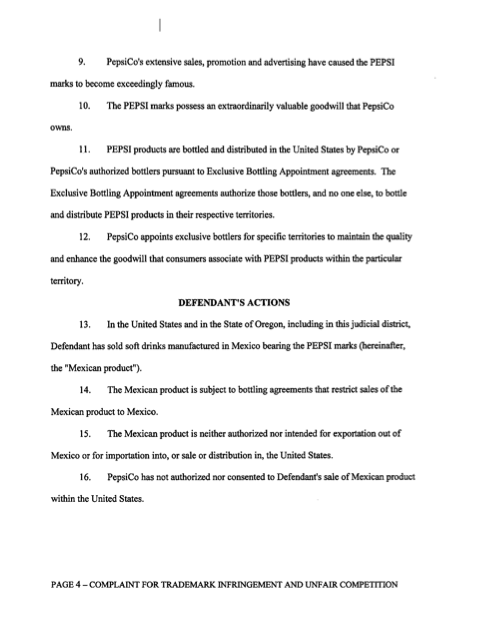
Oregon Trademark Litigation Update – Pepsico v. Su Casa Imports

01 Thursday Apr 2010

Posted by Kenan Farrell in Intellectual Property, Litigation, Oregon, Trademark

≈ Leave a comment

Tags

Ancer L. Haggerty, Federal Unfair Competition, Pepsico, Su Casa Imports, Trademark Infringement, Unfair Competition

Court Case Number: 3:10-cv-00330-HA
File Date: Thursday, March 25, 2010
Plaintiff: Pepsico, Inc.
Plaintiff Counsel: J. Peter Staples of Chernoff Vilhauer McClung & Stenzel LLP
Defendant: Su Casa Imports, Inc.
Cause(s): Federal Trademark Infringement, Federal Unfair Competition, Oregon Trademark Infringement and Unfair Competition
Court: Oregon District Court
Judge: Judge Ancer L. Haggerty

…

Please leave a comment if you’d like a full copy of the complaint.

Google denied Nexus One trademark registration

19 Friday Mar 2010

Posted by Kenan Farrell in Intellectual Property, Oregon, Trademark

≈ Leave a comment

Tags

Integra Telecom, Nexus One, Trademark

It’s been a rough day for Google’s Android phone, the Nexus One. Initial sales have been far weaker than the iPhone saw when it first came out of the gate. Now it’s being reported that the U.S. Patent and Trademark Office has rejected its application for a trademark on the name Nexus One.

The name “Nexus One” was ruled too close to Portland, Oregon-based Integra Telecom‘s own registered trademark for its Nexus fixed bandwidth integrated voice and internet T1 product.

For the full story, check out ReadWriteWeb.

Oregon Trademark Litigation Update – NetBiz v. Global Market Exposure Corp.

19 Friday Mar 2010

Posted by Kenan Farrell in Intellectual Property, Litigation, Oregon, Trademark

≈ Leave a comment

Court Case Number: 3:10-cv-00265-HU
File Date: Friday, March 12, 2010
Plaintiff: NetBiz, Inc.
Plaintiff Counsel: Daniel P. Larsen, Stacey E. Mark of Ater Wynne, LLP
Defendant: Global Market Exposure Corp., Alex Lockwood
Causes: Breach of Noncompete Agreement, Defamation, Federal Unfair Competition and False Advertising, State Trademark Infringement, State Trademark Dilution, State Unfair Competition, Tortious Interference,
Court: Oregon District Court
Judge: Magistrate Judge Dennis J. Hubel

Please leave a comment if you’d like a copy of the full complaint.

Oregon Trademark Litigation Update – Adidas America v. Calmese

14 Wednesday Oct 2009

Posted by Kenan Farrell in Intellectual Property, Litigation, Oregon, Trademark

≈ Leave a comment

Oregon Trademark Litigation Update:

Adidas America v. Calmese
No. 08-CV-91-ST (October 7, 2009)
U.S. District Court, Oregon
Before: Brown

For Full Opinion:
2009 U.S. Dist. LEXIS 94690

TRADEMARK; LIKELIHOOD OF CONFUSION  (Defendant failed to show likelihood of confusion even though the court found Defendant had fanciful or arbitrary mark, similar business channels, and bad faith on the part of plaintiff.)

Opinion (Brown): Defendant Calmese registered a trademark in the phrase “prove-it!” Plaintiff Adidas America used the same phrase on a line of t-shirts. Plaintiff sued defendant for declaratory judgment of non-infringement. Plaintiff moved for summary judgment. The district court held three factors of the likelihood of confusion test weighed in favor of Defendant: Defendant’s mark was fanciful or arbitrary, both parties sold goods in the Phoenix, Arizona area, and therefore operated in similar business channels, and Plaintiff had actual or constructive knowledge of Defendant’s trademark, thus showing bad faith on the part of Plaintiff. However, Plaintiff’s goods were not related to Defendant’s goods, the marks used lacked similarity, and Defendant showed no evidence of actual confusion. The court held Defendant failed to show any likelihood of confusion. Plaintiff’s motion for summary judgment granted.

Source: Willamette Law Online

adidas_logo

Copyright and Trademark Issues For Blogs

21 Monday Sep 2009

Posted by Kenan Farrell in Copyright, Intellectual Property, Oregon, Trademark

≈ Leave a comment

Tags

Copyright, Intellectual Property, Trademark

This post begins a series dealing specifically with the legal issues that bloggers should be thinking about. First up are intellectual property issues, helping you understand your rights to link to information or graphics from other sources, quote from articles and blogs, or otherwise use someone else’s copyrighted works. It will also discuss the appropriate use of trademarks in blogs (both your marks and those of others).

I. Overview of Intellectual Property

What is copyright?

Copyright gives a creative person control over the use of an original work of authorship. A copyright owner has the exclusive right to reproduce a work, prepare derivative works, distribute copies or perform a work publicly. In the world of bloggers, original works of authorship can include text, images, audio or video creations (and a whole host of other things).

What is trademark?

A trademark is a distinctive sign or indicator used to identify that the products or services with which the trademark appears originate from a unique source, and to distinguish its products or services from those of other entities.

So think:

Pepsi®, McDonalds®, Apple®

Or:

pepsi logo mcdonalds apple logo

When you either hear/read the word mark or see the logo mark, you immediately associate that trademark with a particular product or service. Obviously, these are examples of very strong trademarks.

II. Copyright

Copyright issues start to come into play when you publish material created by others on your blog or, conversely, when someone else republishes material that you posted on your blog or website.

Copyright law applies to the reposting of text, images, audio and video. If you’re posting somebody else’s original work, you’re likely violating one of the exclusive rights mentioned above. But as you, me and anyone else on the Internet knows, people are copy/pasting, hyperlinking and cross-referencing all over the world, all the time. Are they all liable for copyright infringement? Luckily, the Copyright Act has a built-in exception called “fair use” that allows you to use other people’s copyrighted works for certain, enumerated purposes. These include criticism, comment, news reporting, teaching, scholarship or research. So, for example, if you are commenting on or criticizing an item that someone else has posted, and use a quote from that source, that’s probably fair use.

The following factors are considered in a fair use analysis:

  1. the purpose and character of the use, including whether such use is of a commercial nature or is for nonprofit educational purposes;
  2. the nature of the copyrighted work;
  3. the amount and substantiality of the portion used in relation to the copyrighted work as a whole; and
  4. the effect of the use upon the potential market for or value of the copyrighted work.

Keep in mind that the law favors “transformative” use. In other words, if you’re reposting another person’s original work, it’s more likely to be fair use if you’re using that work in a different manner or for a different purpose than the original. While you may borrow directly from another source, adding your own commentary and content is better than strict copying. Likewise, it’s better to repost only a small portion of someone else’s work than the work in its entirety.

bloggerdilemma

If you feel that you’ve gone too far in your copying, you probably have. Consider whether you’re able to share the same information but in a different way (i.e. your own words). If you can’t, that’s strong evidence it’s a fair use. Don’t worry if you’re confused…this is a gray area in copyright law that isn’t totally clear to anyone at the moment. If you have specific questions about your use of someone else’s creative works or someone else is using your works, contact a copyright professional (who should be well-versed on legal developments and what typically constitutes fair use) to provide a more detailed analysis.

Barneyª: Sharing is Caring DVD Box ArtAlso, on a practical note, if you’re using someone else’s text or images and they contact you to ask you to remove them, you probably just want to go ahead and do it. After all, there are lots of different ways to express an idea and usually hundreds of equally wonderful pictures to adorn your blog. On the other side, if you find someone else using your text or images, take a deep breath before contacting them and remember what Barney says about sharing:

III. Trademark

Let’s talk first about your own trademarks. Often you’ll have spent good time and money developing and protecting your trademarks. It would be a shame to lose your rights through improper use. Proper use enhances a mark’s ability to identify the origin of products or services, and minimizes the likelihood that a mark will become generic, or be abandoned unintentionally. Make sure you always use a proper trademark notice (™ for common law rights, ® if you’ve obtained registration) and remember to use your trademark as an adjective. Escalator was once a registered trademark but rights were lost when everyone started using the term as a noun to describe just any ol’ moving stairway. The mark no longer brought to mind its owner as the single origin of the product.

It’s probably just as common that you’ll post someone else’s trademark…I know this blog, as a news and information source, posts 3rd-party trademarks fairly regularly. This is typically permissible, because while trademark law prevents you from using someone else’s trademark to sell your competing products, it doesn’t stop you from using the trademark to refer to the trademark owner or its products. That is called “nominative fair use,” and is permitted if using the trademark is necessary to identify the products, services, or company you’re talking about, and you don’t use the mark to suggest the company endorses you. Again, bloggers get by on an exception to the rule…we are living in a gray legal realm. Consult a trademark professional if you’re concerned about your use of somebody else’s trademark.

trademarknotice

The next post in the series will discuss defamation. The post will explore your options when somebody has posted something false and damaging about you, including some common defenses. Until next time, sticks and stones, my friends!


BSU Files Trademark Lawsuit Against Fred Meyer

02 Wednesday Sep 2009

Posted by Kenan Farrell in Litigation, Oregon, Trademark

≈ Leave a comment

Boise State University is suing Portland-based grocery chain Fred Meyer for trademark infringement on merchandise being sold in advance of this week’s football showdown against Oregon.

The lawsuit filed in U.S. District Court in Boise last Thursday accuses the grocer of selling blue and orange shirts at several stores close to the BSU campus and adjacent to officially sanctioned apparel.  The shirts include statements like “Duck Season” and “Buck the Ducks,” and feature pictures of a bronco kicking a duck.

University lawyers contend the shirts were not officially licensed through the school’s licensing agent and infringe on name and color scheme trademarks.

School officials have been working to resolve the matter, and the grocery chain has reportedly been cooperative.  Shirts are being removed from stores, so if you’ve already bought one, consider it a collectors’ item.

The No. 14 Broncos open the season Thursday night at home against No. 16 Oregon.

duck

Oregon Trademark Litigation Update – Relativity Rogue, LLC v. Oregon Brewing Company

25 Tuesday Aug 2009

Posted by Kenan Farrell in Litigation, Oregon, Trademark

≈ Leave a comment

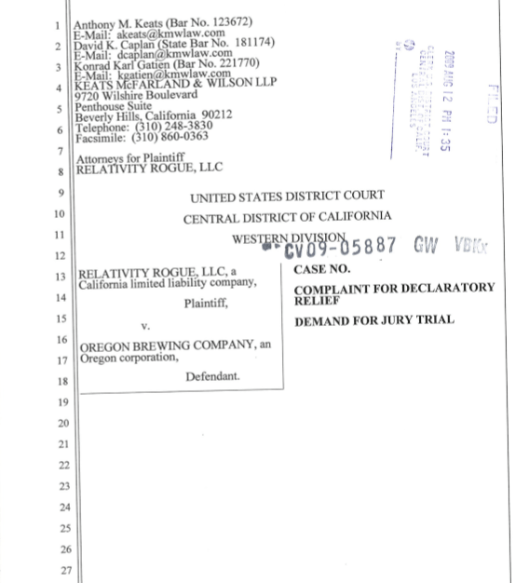
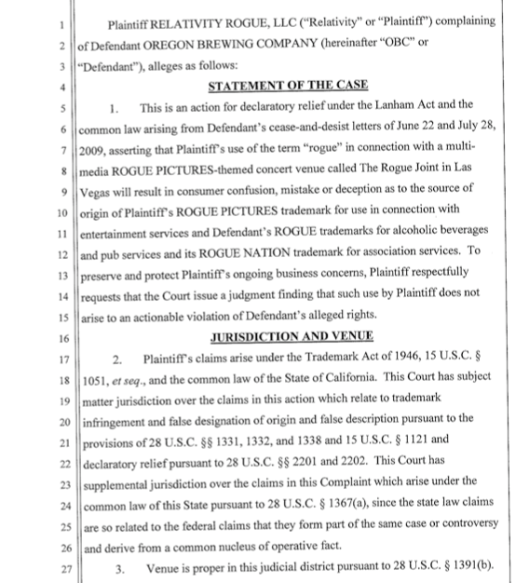
Case Number: 2:09-cv-05887-GW-VBK
File Date: Wednesday, August 12, 2009
Plaintiff: Relativity Rogue, LLC
Plaintiff Counsel: Anthony M. Keats, David K. Caplan, Konrad K. Gatien of Keats McFarland & Wilson LLP
Defendant: Oregon Brewing Company
Cause: 15:1051 Trademark Infringement
Court: California Central District Court
Judge: Judge George H. Wu
Referred To: Magistrate Judge Victor B. Kenton

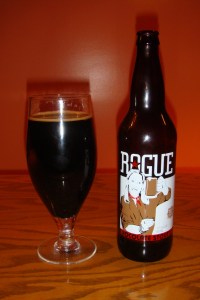
roguestout

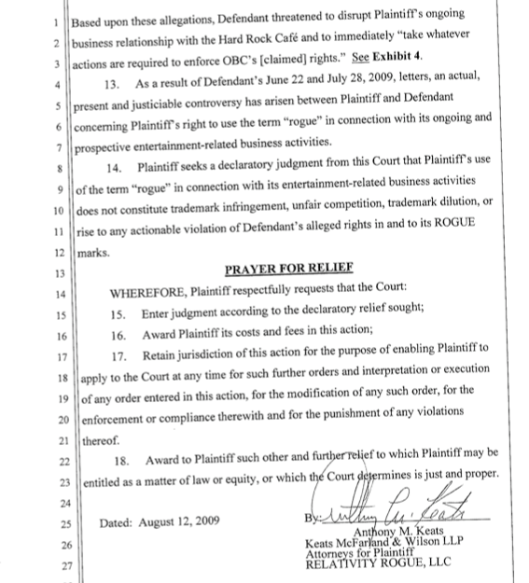
A California-based film production company named Relativity Rogue (“Relativity”) has filed an action for declaratory relief against Oregon Brewing Company (“OBC,” a.k.a. the makers of fine Rogue ales).  OBC sent cease & desist letters in June and July, 2009, asserting that Relativity’s use of the term “rogue” in connection with a multi-media ROGUE PICTURES-themed  concert venue called The Rogue Joint in Las Vegas will result in consumer confusion with OBC’s ROGUE trademarks for alcoholic beverages.  Rather than quibble about it, Relativity decided it would just go ahead and have the issue decided by the California Central District Court, filing this Complaint for Declaratory Relief.  Relativity seeks a judgment that it’s use of the term “rogue” in connection with its entertainment-related business activities does not constitute trademark infringement, unfair competition, trademark dilution, or rise to any actionable violation of OBC’s rights in the ROGUE marks.  Way to take the initiative, Relativity!

This quick trigger by Relativity makes me think this is either a part of their settlement strategy or the parties just came to an impasse in negotiations.  Either way, the court will now attempt to settle their rights in the public eye, for better or worse.  I’ll update you as this matter proceeds.

Picture 1

Picture 2

Picture 3

For a copy of the full complaint, please leave a comment with your email.

Oregon Man Sentenced for First-Degree Trademark Counterfeiting

29 Wednesday Jul 2009

Posted by Kenan Farrell in Intellectual Property, Litigation, Trademark

≈ Leave a comment

OREGON CITY — A Happy Valley man will serve 40 days in jail for selling counterfeit Rolex watches, iPods and designer apparel on the Internet.  Gordon Kean Dye, 52, also will pay a $500 fine, pay for his extradition from Texas and remain on probation for two years after he completes his jail term.

Dye was arrested by FBI agents in September 2008, during a crackdown on intellectual property rights violations. After agents obtained a search warrant, they found Dye with several bogus items he bought in Mexico, including 20 bogus Rolex watches, Coach handbags, Nike apparel and items bearing the prestigious Prada label. The counterfeit goods were manufactured in China.

rolex

Dye faced charges in both Washington and Clackamas counties. Prosecutors in both counties worked together and negotiated coordinated pleas.

On Friday, Dye pleaded guilty in Washington County Circuit Court to second-degree trademark counterfeiting.

Today, he pleaded guilty in Clackamas County Circuit Court to first-degree trademark counterfeiting, second-degree trademark counterfeiting and third-degree trademark counterfeiting.

Dye offered a simple apology to Judge Steven L. Maurer.

“I’m sorry for being here, your honor, in this courtroom,” he said.

Source: The Oregonian

coach-patch-tote

The Trademark Counterfeiting statute appears below.  Click the links above to see the penalty for each degree of counterfeiting.

CHAPTER 647—Trademarks and Service Marks; Oregon Revised Statutes 647.135
(1) A person commits trademark counterfeiting if the person knowingly and with the intent to sell or distribute and without the consent of the registrant uses, displays, advertises, distributes, offers for sale, sells or possesses any item that bears a counterfeit of a mark or any service that is identified by a counterfeit of a mark registered under this chapter or registered under this chapter or registered under 15 U.S.C. 1052 with knowledge that the mark is counterfeit.

(2) For purposes of this section, a mark is counterfeit if:

(a) It is a mark that is identical to or substantially indistinguishable from a registered mark; and

(b) It is used on or in connection with the same type of goods or services for which the genuine mark is registered.

(3) A person does not commit trademark counterfeiting if the person has adopted and lawfully used the same or a confusingly similar mark in the rendition of like services or the manufacture of like goods in this state from a date before the effective date of registration of the service mark or trademark and continues to use the mark after the effective date of registration.

Stay out of trouble, kids!

← Older posts
Newer posts →

Categories

Blog at WordPress.com.

Privacy & Cookies: This site uses cookies. By continuing to use this website, you agree to their use.
To find out more, including how to control cookies, see here: Cookie Policy
  • Subscribe Subscribed
    • Oregon Intellectual Property Blog
    • Join 147 other subscribers
    • Already have a WordPress.com account? Log in now.
    • Oregon Intellectual Property Blog
    • Subscribe Subscribed
    • Sign up
    • Log in
    • Report this content
    • View site in Reader
    • Manage subscriptions
    • Collapse this bar
 

Loading Comments...