• About
  • Contact
  • Disclaimer
  • Oregon IP Resources

Oregon Intellectual Property Blog

Oregon Intellectual Property Blog

Category Archives: Litigation

BSU Files Trademark Lawsuit Against Fred Meyer

02 Wednesday Sep 2009

Posted by Kenan Farrell in Litigation, Oregon, Trademark

≈ Leave a comment

Boise State University is suing Portland-based grocery chain Fred Meyer for trademark infringement on merchandise being sold in advance of this week’s football showdown against Oregon.

The lawsuit filed in U.S. District Court in Boise last Thursday accuses the grocer of selling blue and orange shirts at several stores close to the BSU campus and adjacent to officially sanctioned apparel.  The shirts include statements like “Duck Season” and “Buck the Ducks,” and feature pictures of a bronco kicking a duck.

University lawyers contend the shirts were not officially licensed through the school’s licensing agent and infringe on name and color scheme trademarks.

School officials have been working to resolve the matter, and the grocery chain has reportedly been cooperative.  Shirts are being removed from stores, so if you’ve already bought one, consider it a collectors’ item.

The No. 14 Broncos open the season Thursday night at home against No. 16 Oregon.

duck

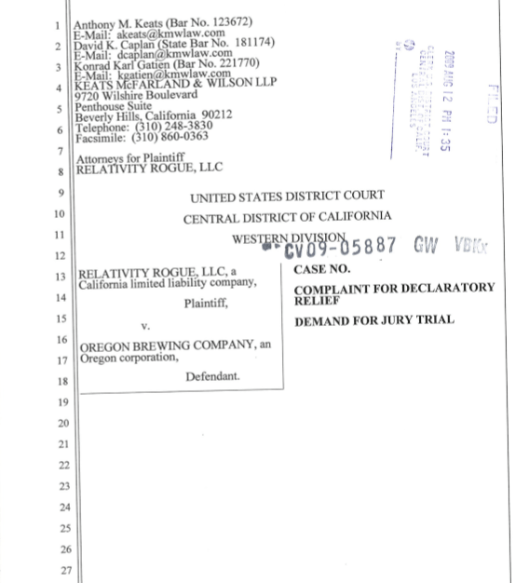
Oregon Trademark Litigation Update – Relativity Rogue, LLC v. Oregon Brewing Company

25 Tuesday Aug 2009

Posted by Kenan Farrell in Litigation, Oregon, Trademark

≈ Leave a comment

Case Number: 2:09-cv-05887-GW-VBK
File Date: Wednesday, August 12, 2009
Plaintiff: Relativity Rogue, LLC
Plaintiff Counsel: Anthony M. Keats, David K. Caplan, Konrad K. Gatien of Keats McFarland & Wilson LLP
Defendant: Oregon Brewing Company
Cause: 15:1051 Trademark Infringement
Court: California Central District Court
Judge: Judge George H. Wu
Referred To: Magistrate Judge Victor B. Kenton

roguestout

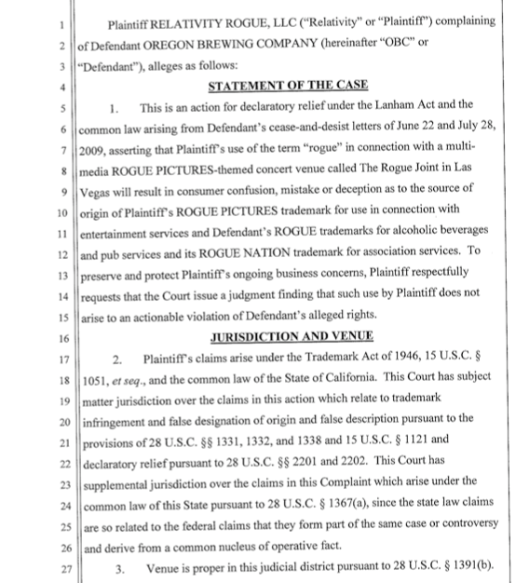
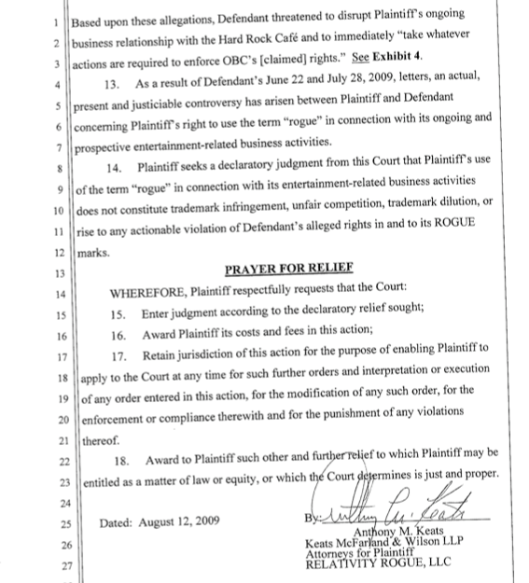
A California-based film production company named Relativity Rogue (“Relativity”) has filed an action for declaratory relief against Oregon Brewing Company (“OBC,” a.k.a. the makers of fine Rogue ales).  OBC sent cease & desist letters in June and July, 2009, asserting that Relativity’s use of the term “rogue” in connection with a multi-media ROGUE PICTURES-themed  concert venue called The Rogue Joint in Las Vegas will result in consumer confusion with OBC’s ROGUE trademarks for alcoholic beverages.  Rather than quibble about it, Relativity decided it would just go ahead and have the issue decided by the California Central District Court, filing this Complaint for Declaratory Relief.  Relativity seeks a judgment that it’s use of the term “rogue” in connection with its entertainment-related business activities does not constitute trademark infringement, unfair competition, trademark dilution, or rise to any actionable violation of OBC’s rights in the ROGUE marks.  Way to take the initiative, Relativity!

This quick trigger by Relativity makes me think this is either a part of their settlement strategy or the parties just came to an impasse in negotiations.  Either way, the court will now attempt to settle their rights in the public eye, for better or worse.  I’ll update you as this matter proceeds.

Picture 1

Picture 2

Picture 3

For a copy of the full complaint, please leave a comment with your email.

Green Startup Sues Printing Giant in Oregon District Court

05 Wednesday Aug 2009

Posted by Kenan Farrell in Litigation, Patent, Trade Secret

≈ Leave a comment

greenprojectlogoA local green startup firm has counter-sued a printing giant, claiming that it illegally cracked down on the right to resell its used product.

Hacienda Heights-based Green Project Inc. alleges in a lawsuit filed July 27 in U.S. District Court in Oregon that Epson America Inc. and its parent, Japan-based Seiko Epson Corp., sent a company spy into the Green Project facility to gain access to trade secrets.

The company also claims that Epson punished it and firms like it for reselling recycled Epson cartridges.

Epson, which first filed a lawsuit against Green Project and several other firms in April over alleged patent infringement, denies all charges.

“My reaction (to the allegations) is they are B.S. and designed to create a posture for Green Project … and that there’s no substance to them,” said David W. Axelrod, a lead attorney for Epson. But in its countersuit, Green Project says Epson’s infringement claims don’t stand up against the “first sale doctrine,” a legal approach that says a patent owner’s rights to intellectual property end once a particular product has been sold to the public. Green Project, a company of 13 employees, does business by “re-manufacturing” ink and toner cartridges for use on major manufacturers’ printers, including Epson’s.

The year-old company touts the service as good for the environment, since it takes discarded cartridges and puts them to new use.

“It’s not that we are looking for p.r.,” said Green Project President Joseph Wu. “Our goal is to recycle Epson’s cartridges. If we don’t, they go to landfills. We are recycling and looking to reduce e-waste, but also to make a business.”

EpsonLogoThe company thought it was doing business when Herbert W. Seitz allegedly called – using another name – looking to buy cartridges from Green Project and ultimately sell them at his Huntington Beach firm, Wu said. As part of that business, Green Project sent price lists and other secret information to Seitz, who turned out to be an Epson employee, Wu alleged, adding that within a couple of days, Seitz showed up in the company warehouse without permission.

“The issue is that when Epson did come to us, they came under false pretenses,” Wu said.

Green Project accuses Epson – one of the largest manufacturers of printers – of trade secret misappropriation and trespassing, and denies Epson’s claims of patent infringement.

But Epson’s lawyers maintain they have a case against Green Project.

Axelrod pointed to the “first sale” doctrine, adding that the doctrine of first sale does not apply in this case, because there is evidence the used cartridges were collected out of the U.S. Wu said his firm works with brokers who document that cartridges were collected in the U.S.

Wu’s company is seeking to be dropped from Epson’s original suit, and for Epson to pay damages and legal fees. It’s also looking to stop Epson from using any secrets that Seitz allegedly obtained.

Epson wants the firms named in the lawsuit to pay damages and for its patents to be enforced.

Source: SGVTribune.com

Oregon Man Sentenced for First-Degree Trademark Counterfeiting

29 Wednesday Jul 2009

Posted by Kenan Farrell in Intellectual Property, Litigation, Trademark

≈ Leave a comment

OREGON CITY — A Happy Valley man will serve 40 days in jail for selling counterfeit Rolex watches, iPods and designer apparel on the Internet.  Gordon Kean Dye, 52, also will pay a $500 fine, pay for his extradition from Texas and remain on probation for two years after he completes his jail term.

Dye was arrested by FBI agents in September 2008, during a crackdown on intellectual property rights violations. After agents obtained a search warrant, they found Dye with several bogus items he bought in Mexico, including 20 bogus Rolex watches, Coach handbags, Nike apparel and items bearing the prestigious Prada label. The counterfeit goods were manufactured in China.

rolex

Dye faced charges in both Washington and Clackamas counties. Prosecutors in both counties worked together and negotiated coordinated pleas.

On Friday, Dye pleaded guilty in Washington County Circuit Court to second-degree trademark counterfeiting.

Today, he pleaded guilty in Clackamas County Circuit Court to first-degree trademark counterfeiting, second-degree trademark counterfeiting and third-degree trademark counterfeiting.

Dye offered a simple apology to Judge Steven L. Maurer.

“I’m sorry for being here, your honor, in this courtroom,” he said.

Source: The Oregonian

coach-patch-tote

The Trademark Counterfeiting statute appears below.  Click the links above to see the penalty for each degree of counterfeiting.

CHAPTER 647—Trademarks and Service Marks; Oregon Revised Statutes 647.135
(1) A person commits trademark counterfeiting if the person knowingly and with the intent to sell or distribute and without the consent of the registrant uses, displays, advertises, distributes, offers for sale, sells or possesses any item that bears a counterfeit of a mark or any service that is identified by a counterfeit of a mark registered under this chapter or registered under this chapter or registered under 15 U.S.C. 1052 with knowledge that the mark is counterfeit.

(2) For purposes of this section, a mark is counterfeit if:

(a) It is a mark that is identical to or substantially indistinguishable from a registered mark; and

(b) It is used on or in connection with the same type of goods or services for which the genuine mark is registered.

(3) A person does not commit trademark counterfeiting if the person has adopted and lawfully used the same or a confusingly similar mark in the rendition of like services or the manufacture of like goods in this state from a date before the effective date of registration of the service mark or trademark and continues to use the mark after the effective date of registration.

Stay out of trouble, kids!

Sotomayor’s Supreme Court Case History – Intellectual Property

27 Wednesday May 2009

Posted by Kenan Farrell in Intellectual Property, Litigation

≈ Leave a comment

During Supreme Court nominee Sonia Sotomayor’s 17 years as a federal judge, the U.S. Supreme Court has reviewed her decisions on at least eight occasions, including the following copyright case:

Tasini vs. New York Times, et al (1997), 972 F. Supp. 804: As a district court judge in 1997, Sotomayor heard a case brought by a group of freelance journalists who asserted that various news organizations, including the New York Times, violated copyright laws by reproducing the freelancers’ work on electronic databases and archives such as “Lexis/Nexis” without first obtaining their permission. Sotomayor ruled against the freelancers and said that publishers were within their rights as outlined by the 1976 Copyright Act. The appellate court reversed Sotomayor’s decision, siding with the freelancers, and the Supreme Court upheld the appellate decision (therefore rejecting Sotomayor’s original ruling). Justices Stevens and Breyer dissented, taking Sotomayor’s position.

Source: CNN

Newer posts →

Categories

Create a free website or blog at WordPress.com.

Privacy & Cookies: This site uses cookies. By continuing to use this website, you agree to their use.
To find out more, including how to control cookies, see here: Cookie Policy
  • Subscribe Subscribed
    • Oregon Intellectual Property Blog
    • Join 147 other subscribers
    • Already have a WordPress.com account? Log in now.
    • Oregon Intellectual Property Blog
    • Subscribe Subscribed
    • Sign up
    • Log in
    • Report this content
    • View site in Reader
    • Manage subscriptions
    • Collapse this bar
 

Loading Comments...